Ghost Cave Font: Hauntingly Beautiful for Handmade Labels & Printables
If you’ve ever spent hours tweaking a candle label only to realize the font feels too cheerful—or too cold—for your moody, mystical brand, Ghost Cave Font is the quiet magic you’ve been missing. As a maker who designs printable wedding suites, boutique tags, and seasonal SVG signs for small shops, I reached for Ghost Cave the moment I saw its first glyph—and haven’t put it down since.
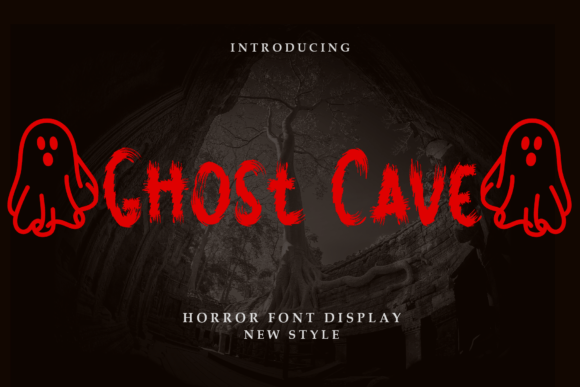
Ghost Cave is a display font with soul. Its letterforms don’t shout; they whisper from the edge of candlelight. Think soft, smudged serifs, subtle tapering strokes, and curves that echo dripping stalactites—not sharp or jagged, but deeply atmospheric. It’s not spooky in a cartoonish way. It’s mysterious, grounded, and quietly elegant—perfect for brands that lean into earthy mysticism, gothic romance, apothecary charm, or even minimalist farmhouse with a twist.
This isn’t a font for body text—and it shouldn’t be. Ghost Cave shines where display fonts belong: on product labels small enough to fit on a 2-inch soap tag, on chalkboard-style welcome signs at rustic weddings, or as the bold title on a printable moon phase planner page. Its readability holds up beautifully at sizes from 14pt (for fine-print boutique tags) all the way up to 200pt (for large-scale wall art or Cricut-cut wooden signs). On my Silhouette Cameo, I’ve cut Ghost Cave cleanly down to 8pt on matte vinyl—just keep kerning tight and avoid ultra-thin shadows if cutting intricate outlines.
I use Ghost Cave most often for three kinds of physical products: product packaging, wedding + event stationery, and seasonal digital printables. For handmade candles and bath salts, pairing Ghost Cave with a clean sans serif like Montserrat or Poppins creates instant contrast—mysterious name, practical ingredient list. On a lavender-scented soy candle? “Midnight Hollow” in Ghost Cave, centered above “Soy • Lavender • Cedar” in light gray sans serif. Customers tell me it feels “curated,” not generic.
For wedding stationery, Ghost Cave brings weight and warmth without formality. I designed a set of printable welcome boards for a couple getting married in a forest lodge—“You Are Here” in Ghost Cave, layered over a watercolor fern texture. It read clearly from six feet away, felt intentional, and matched their “enchanted woods” theme better than any script font I’d tried. It also works beautifully for monogrammed napkin prints, foil-stamped favor tags, and even delicate vellum enclosure cards—its subtle shadowing adds dimension without overwhelming delicate paper stocks.
In my digital printable shop, Ghost Cave anchors themed collections: a “Witchy Planner Bundle” with moon-phase trackers, a “Spooky Season SVG Pack” for Halloween mugs and tote bags, and even a minimalist “Grief Journal” cover that needed dignity, not drama. Because Ghost Cave avoids cliché (no bats, no dripping blood), it lends emotional resonance—not gimmickry—to sensitive or meaningful projects.
What makes Ghost Cave commercially reliable? First, it includes both OTF and TTF files—essential for compatibility across Canva, Cricut Design Space, Silhouette Studio, and Adobe apps. Second, it offers stylistic alternates and ligatures, so “love” or “moon” can have custom-connected forms that feel hand-drawn, not automated. Third, it supports extended Latin characters—enough for French, Spanish, and German product names, which matters when selling internationally on Etsy or Shopify.
Font pairing is where Ghost Cave truly sings. Try it with:
- A soft, rounded script font (like Marcellus SC or Playfair Display Italic) for names or quotes—Ghost Cave as the anchor, the script as the breath.
- A neutral sans serif (like Inter or Manrope) for body copy, ingredients, or sizing charts—clean contrast that keeps focus on your product, not the typography.
- A low-contrast serif (like Lora or Crimson Text) for vintage-inspired packaging—Ghost Cave as headline, the serif as supporting voice.
One note on licensing: Ghost Cave is a commercial font, and its license explicitly covers physical product sales, digital downloads, SVG files, templates, and client work—as long as you’re not reselling the font file itself. That means yes to printing it on tea towels, yes to embedding it in a Canva template sold on Etsy, yes to cutting it on vinyl for resale—but no to uploading the .OTF to a free font site. Always check the included license PDF, but in practice, it’s crafted for makers, not restricted like enterprise fonts.
I’ve tested Ghost Cave across substrates: kraft paper labels, white matte sticker sheets, dark wood signs, ceramic mug decals, and even heat-transfer vinyl on black cotton tees. It retains its character without pixelation or stroke collapse—even at small sizes, thanks to generous x-height and open counters. And because its weight sits between medium and bold (not ultra-heavy), it doesn’t overpower delicate illustrations or botanical line art—making it ideal for herbal apothecary branding or indie perfume labels.
Real talk: Ghost Cave won’t suit every shop. If your brand is bright, bubbly, or hyper-modern, this isn’t your lead font. But if your customers linger over textures, scent notes, handwritten details, and quiet storytelling—Ghost Cave deepens that experience. It tells people, before they even read your description, that what they’re holding was made with intention. Not just printed. Not just assembled. Curated.
Whether you're designing a limited-run holiday collection, refreshing your product tags for Q4, or building a cohesive brand identity across stickers, signage, and digital assets—Ghost Cave is more than a typeface. It’s a mood, a tone, and a subtle signature that helps your handmade goods stand apart on crowded shelves and scrolling feeds alike.